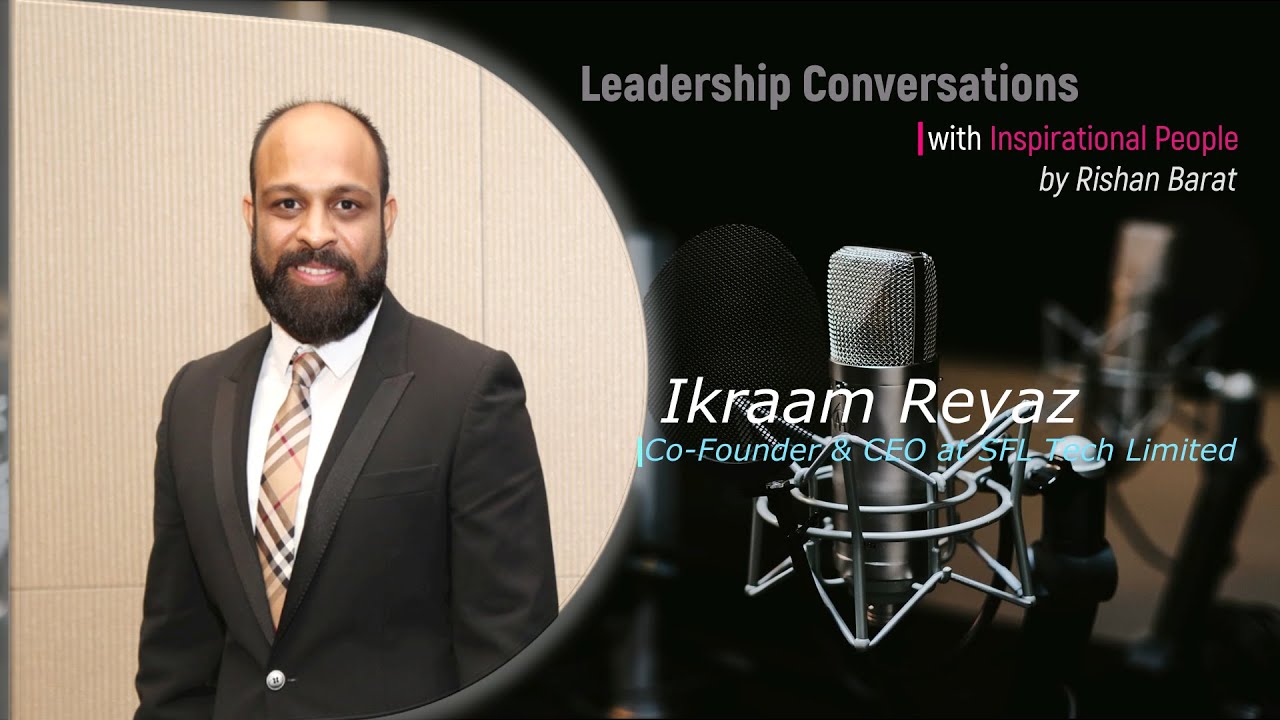
In a conversation with Microsoft leader Rishan Barat, SFL Tech CEO and Co-Founder Ikraam Reyaz reflects on the freight experience that shaped SFL, the leadership lessons he had to learn for himself, and the principle that continues to influence how he thinks about customers and growth.
https://www.youtube.com/watch?v=jKxMGnn8N5M
Long before Ikraam Reyaz was building a technology business for freight forwarders, he was filing shipping documents in his father’s logistics company in Sri Lanka.
It was an unremarkable start to a career that would eventually take him through operational leadership roles across Bangalore, Mumbai, Chennai and New Delhi, and later into entrepreneurship with SFL Tech. But that time inside freight matters. It gave Ikraam something that has remained central to how SFL approaches the industry: an understanding of logistics from the operator’s side of the desk.
In this episode of Rishan Barat’s Leadership Conversations with Inspirational People, the discussion moves from those early years into the decisions, mistakes and principles that shaped Ikraam’s approach to building SFL.
And one idea runs particularly strongly through the conversation: stay close to the problem you understand.
When Ikraam talks about SFL’s early direction, he does not describe a company looking for the largest possible technology market.
He describes deliberate focus.
SFL concentrated on freight forwarding because its founders understood the operation from experience. They had seen where logistics businesses relied heavily on manpower, where technology adoption remained slow, and where operators struggled to translate software investment into practical value.
That familiarity shaped how SFL approached risk as a young business. Rather than moving horizontally into unrelated industries, the company stayed close to logistics and narrowed its attention further to international air and ocean freight forwarding.
As Ikraam puts it in the conversation:
“We understand them, because we were them.”
It is a short line, but it explains a significant part of SFL’s operating philosophy. Domain knowledge was not something added after the technology. It was the starting point.
Looking Beyond the Immediate Customer
The most distinctive idea in the conversation comes when Ikraam explains how he evaluates whether something SFL builds is likely to create genuine value.
He looks beyond SFL’s customer. “Does my customer’s customer need it?”
His reasoning is straightforward: if a technology investment helps a freight forwarder serve its own customer better, then the value of that investment travels further than an internal efficiency gain.
That could mean making information easier to access, improving how freight data is presented, increasing visibility or removing friction from the customer experience. It is also a useful discipline for a technology business. The question shifts attention away from what can be built and towards what is worth building.
Ikraam summarises it later in the discussion:
“If you’re taking care of your customer’s customer, you are automatically taking care of your customer.”
That customer-outwards perspective is one of the stronger threads in the podcast, because it connects technology decisions to the commercial relationship they ultimately support.
Leadership Learned in the Deep End — Then Reconsidered
The conversation is equally open about how Ikraam’s leadership style developed.
His own introduction to management was demanding. When he moved to India to take responsibility for the Bangalore operation of his family’s logistics business, the approach was essentially to give him responsibility and see whether he could handle it.
That experience built resilience, but it did not become the leadership model he wanted to reproduce.
Ikraam describes a more coaching-led approach at SFL: understand where someone is, prepare them properly, and then increase the challenge. He talks about creating space for people to develop rather than assuming pressure alone will produce capability.
That thinking also influenced SFL’s approach to talent. Rather than building the company solely around experienced hires, Ikraam speaks about bringing in graduates and developing people inside the organisation.
The discussion becomes more interesting when he turns the lens back on himself.
Asked about failure, Ikraam points to micromanagement and the possibility that SFL could have grown faster had he stepped away from some smaller decisions earlier. He also speaks about one of the tensions of entrepreneurship: passion can create momentum, but it can also distort judgement.
That is perhaps the most useful leadership point in the conversation. Growth requires more than asking a team to change. At some point, the founder has to change as well.
The Thinking Behind What Came Next
He talks about complementing major logistics platforms rather than trying to replace them, developing SFL’s own technology capabilities, making better use of freight data, and collaborating with specialists where another company could bring deeper expertise.
The language reflects that point in time. The principle underneath it has aged better. SFL did not need to become everything to everyone. It needed to deepen what it could do for the logistics businesses it already understood.
That trajectory is visible in the company today. SFL has since developed into an All-Platinum CargoWise partner with capabilities spanning CargoWise implementation and optimisation, supply-chain transformation, integrations, automation and managed support across more than 50 countries. The service portfolio has widened; the industry focus has remained.
Watch the full conversation with Ikraam Reyaz and Rishan Barat on leadership, entrepreneurship, customer focus and the early thinking behind SFL Tech.








.png)


.png)
.png)